

I have to admit— mainland China is not one of the destinations on my travel list. Yeah I am quite interested in ancient Chinese culture, but I’ve had several interactions with people from mainland China during my trips that made me hesitant to visit their country of origin. I don’t want to say anything that might be misconstrued as xenophobic or discriminatory. I understand that it’s mostly about cultural differences, and some of their habits do seem inappropriate and boorish to people who are used to western practices. I’ve joined them on several tours, and those experiences turned out to be quite unpleasant. One time, I was on a long haul flight full of people from mainland China and that was a nightmare. I don’t want to go into details because it may look like I’m dissing the whole country, but you get my point. All those experiences just made me decide to avoid them whenever possible to avoid any possible conflict. Stories I’ve been hearing from other travelers who have been to mainland China only reinforced this perception. The differences between what’s socially acceptable and what’s not between Chinese culture and Western culture can indeed be jarring.
So you can imagine how I felt when my family decided to visit Shanghai for a vacation. Yeah i was hesitant, but i guess it’s about time I gave the country a try. Besides, Shanghai is a modern city. It would probably be like Hong Kong, meaning it would be as western as a Chinese city can get. And it’s a top tourist destination. Upon further research, i discovered that there are lots of things we can do there. There’s also a bustling expat community, so it can’t be that bad. i doubt that many westerners would choose to live and work there if they found the actions of locals highly inappropriate.
First impressions: Shanghai is modern. And beautiful. I was right in assuming that it would be like Hong Kong. Even the residents are more like Chinese people from Hong Kong— meaning, they mostly act like people who are accustomed to the western world. Sure there are a lot of restrictions. You can’t access social media sites and several blog sites without a VPN (Snapchat works though for some odd reason). Messaging apps don’t work except for WeChat— and I suspect the Chinese government regulates it, which is why it works in the country. Try to ignore those restrictions and you’d feel like you’re in a western city. As long as you’ve got nothing to hide, it’s easy to forget that big brother is probably watching your every move. There are lots of international retail stores as well as restaurants. There’s also a bustling night life with no apparent restrictions (at least I didn’t notice any). There’s no apparent perennial government presence, which was something some people had led me to believe. The influence of communism might be more apparent elsewhere in China, but I barely noticed it in Shanghai. The only place I noticed this was at the Museum of the First National Congress of the Chinese Communist Party. Again I have to be careful with what I say because it might be misconstrued as me dissing their culture, but it really felt odd as i was walking through that place and as I read about the history of communism. It felt as if i was transported into another dimension. Communism is really one concept that I can never really understand. It’s a must visit though place though if you want to learn about the country’s history.


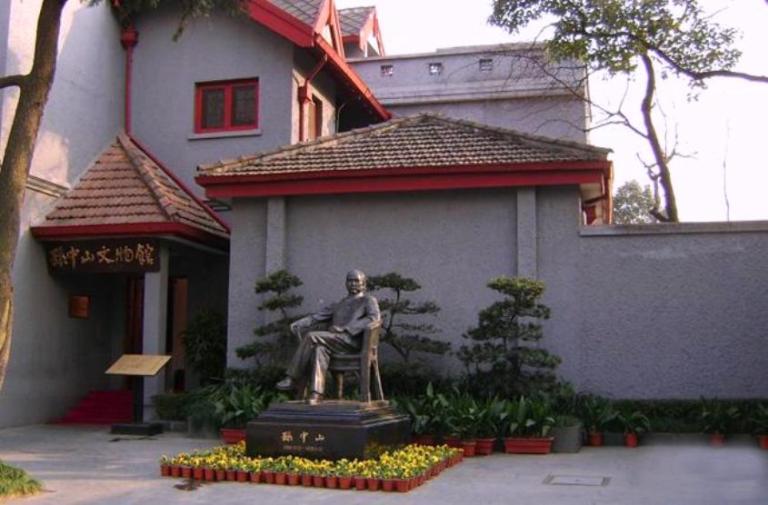
Another must visit place if you wanna learn about the history of China is the former residence of Sun Yat-Sen. It’s an old house converted to a museum, and you’ll learn a great deal about the life of this Chinese Revolutionary and political leader.
There are more museums scattered around the city dealing with the country’s rich history and you can easily visit each one. There are other historical attractions too if all you want to see are Chinese architecture. Perhaps the most famous one is the Yu Garden, which was built way back in the 16th century. It’s a beautiful place to visit during the daytime, but visiting during the night time makes it a surreal experience. Those lights make all the difference.


Farther from the city center is Zhujiajiao. It’s an ancient water village that I highly recommend visiting. it’s incredibly touristy and I’m not sure how authentic it is since there seemed to be a preponderance of shops and restaurants catering mainly to tourists. The architecture is intact though, and the entire place still gives you a feeling that you are transported back a few centuries. One can easily take a cab to get there, it costs about 200 Yuan each way. Pretty hefty, but the place is also easily accessible by bus at the Puanlu or Ti Yu Guan stations. Public transport can prove to be difficult thought since a lot of signs are in Chinese only. It’s also hard to ask around if you get lost since most people only speak Chinese. One way around this would be to ask the staff at your hotel or hostel to help you out. A lot of them have ready made cards with Chinese translations of specific places so you can just show people these cards and they can point you toward your destination if you’re already in the vicinity. I advise to plan your routes well in advance though so you won’t get lost. Google maps doesn’t work but Chinese made map apps do and I found them to be fairly accurate.


We also ended up visiting the local zoo. I’m not really too keen on zoos. I’ve visited zoos in many countries and most of them do not really offer anything that would set them apart from others. The Shanghai zoo has its own Panda research and conservation center though, and this makes it different from zoos in other countries. Sure, I’ve seen Pandas in other zoos, but I haven’t seen so many in one place. They also have baby Pandas, and you can learn a lot about their conservation efforts as you walk through several exhibits.


One part of the zoo was like a safari. You board a bus that would run through several areas where wild animals roam free. i was kinda underwhelmed since I’ve already been on a real safari in Africa, but I can understand why all the people around me got so excited every time a bear, a tiger, or a lion approached the bus windows.


If you’re not in the mood to go far, there are a lot of sights around the city center that are worth visiting. Shanghai’s promenade, also known as the Bund, is a famous attraction and it’s not hard to see why. The panoramic view is even more gorgeous during the night time when all the city lights are up. One can take a cruise or simply sit back and relax at the many establishments on the river bank. Another famous landmark is the Oriental Pearl Tower. It’s a sight to behold when you’re on ground level. Make it up the tower and you’ll be rewarded with an amazing view of the city.
For any traveler who’s hesitant to visit mainland China, Shanghai would be an ideal place to start to avoid any form of culture shock. The city offers a glimpse of Chinese culture and it gives you enough background on Chinese laws. Being in Shanghai also feels like being in any modern western city, so most visitors would not feel out of place.


 no roads to follow